The events of The Videshi Dilemma take place nearly one thousand years in the future, in the year 2996. Western civilization collapsed long ago, unable to cope with catastrophic sea level rise drowning many heavily-populated areas, leaving African and Asian alliances to prosper in its place. Crewed interstellar flight began in the 23rd century, followed by centuries of exploration and terraforming suitable planets.
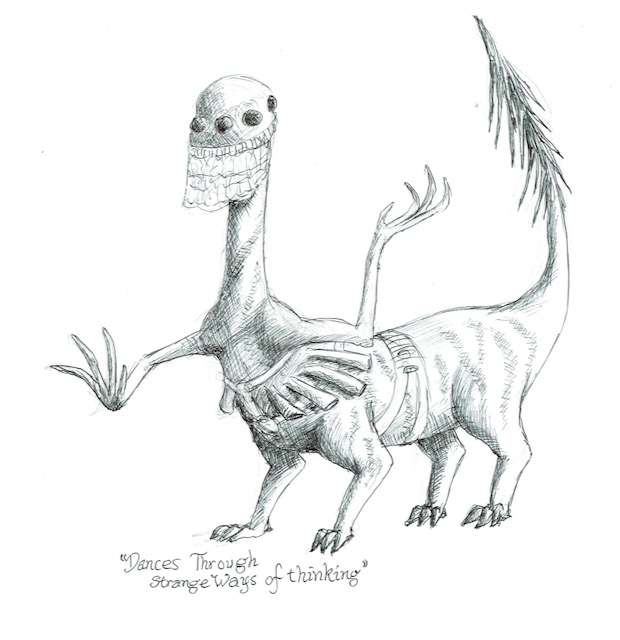
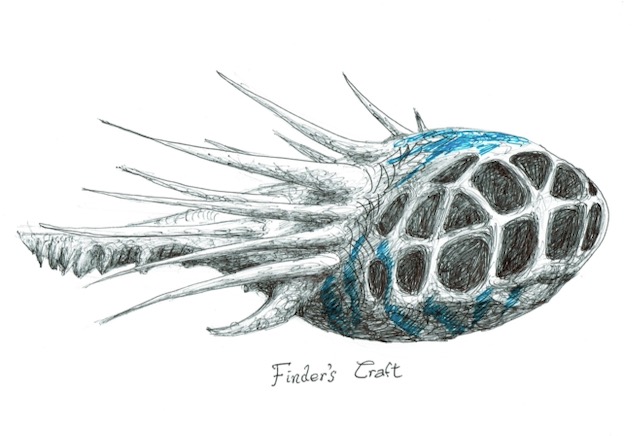
Jonathan’s notebook
After the mission, Jonathan made extensive notes and sketches of his experiences.

Notes on the structure of a typical Videshi hive


Space travel
A realistic basis for interstellar flight was discovered by Mitsumi Okada in the 22nd century, using a field that folds space to create a navigable wormhole. A secondary effect of the Okada field provides reactionless thrust in normal space. It took another fifty years to develop a workable field generator and more decades to overcome other technical limitations. The field takes a vast amount of power to create a usable wormhole, and suitably ‘flat’ regions of space to navigate safely. Interstellar ships are large, and spend days to weeks traveling in normal space to reach charted jump points.
How do we experience gravity in space?
Heavy hauler Herald of Freedom
The heavy hauler Herald of Freedom is a 320m diameter sphere. Internal arrangements are dominated by the Okada core surrounded by eight fusion generators radiating symmetrically out from the core in a 3D-cruciform pattern. Hangars, storage, and living space fit into the wedges in between.
Terraforming
The terraforming process takes centuries and progresses through a number of recognized stages. A colony is classified by the stage it has fully achieved, so a stage-4 world, for example, has a habitable surface.
Stage 0: Initial state, must have some atmosphere and surface water and suitable conditions for development.
Stage 1: Seed with cyanobacteria tailored to local conditions, to thicken, clean, and oxygenate the atmosphere. 50 to 100 years. Results in surface conditions ready to support primitive engineered life.
Stage 2: Seed transitional organisms to establish stable soil, water, and nutrient cycles. 100 to 150 years. Transitional ecosystems established with primitive organisms.
Stage 3: Increase biomass and diversity. 100 to 150 years. Ends with stable ecosystems with complex organisms.
Stage 4: Fine tune the environment, replace transitional engineered organisms with natural species. 50 to 100 years. Results in an open surface habitable for humans and natural organisms. Prior to this point, local population is dependent on enclosed living environments and imported supplies.
Stage 5: Grow population and establish local food and resource production. Population self-sufficient to maintain an agrarian low-tech society in the event of loss of contact with other worlds.
Stage 6: Develop local industrial and technical base. Colony self-sufficient to maintain an advanced technological society.
 Ian S. Bott, Writer and artist